

 In April 2026, the Department of Education finalized a rule redefining advanced nursing programs as graduate degree programs rather than professional for federal student loan purposes. However, a federal judge has temporarily blocked enforcement of that revised definition while a legal challenge moves forward.
Update as of June 2026
U.S. District Judge Beryl A. Howell has temporarily blocked the Department of Education from enforcing its revised definition of a “professional degree” while a legal challenge moves forward.
Lawsuits filed by several nursing and education organizations argue that the Department exceeded its authority by excluding graduate nursing and other healthcare programs from the professional degree category.
In her ruling, Howell agreed the plaintiffs were likely to win, finding that Congress had adopted the existing 2025 definition of a professional degree and that the Department likely overstepped its authority by replacing it with a more restrictive definition requiring programs to prepare graduates to practice independently without supervision. As a result, the court concluded the Department’s new definition was likely unlawful under the Administrative Procedure Act (APA).
The ruling doesn’t eliminate the federal graduate borrowing caps. Instead, it pauses the Department’s revised definition of the professional degree, allowing graduate nursing students pursuing MSN, DNP, or DNAP degrees to remain eligible for the higher professional loan limits while the case continues. However, students pursuing PhD nursing degrees may still face uncertainty, as the ruling doesn’t extend the same protections to research-focused doctoral programs.
According to Federal Student Aid, the temporary ruling also preserves professional degree classification for several other healthcare disciplines, including physical therapy, occupational therapy, athletic training, speech-language pathology, physician assistant/associate, and anesthesiologist assistant programs.
Nursing professional degree definition unchanged in finalized loan rule
The conversation around nursing’s professional degree definition has taken another important turn. Following proposed changes to federal student loan policies affecting certain graduate programs last year, the U.S. Department of Education has now finalized the rule as of April 30, 2026, establishing new borrowing limits for students enrolled in graduate and professional programs.
This update may influence how nursing education is financed, how student debt is managed, and the extent to which advanced nursing degrees remain financially accessible for some individuals.
Where advanced nursing degrees fit with the new ruling
Proposed changes to federal student loan borrowing introduced new considerations for how certain graduate programs, including advanced nursing degrees, are classified. Central to these changes is the distinction between standard graduate programs and those designated as professional degrees. Fields such as medicine, dentistry, and law have traditionally held this designation, allowing students in these programs to access higher federal loan borrowing limits.
Graduate-level nursing education shares many similarities with these professions in both scope and rigor. Pathways, such as the Master of Science in Nursing (MSN), Doctor of Nursing Practice (DNP), and Doctor of Nurse Anesthesia Practice (DNAP), require a substantial investment of time, financial resources, and clinical training.
These programs often include:
- High tuition and overall educational costs
- Extensive hands-on clinical training
- A direct role in supporting healthcare delivery systems
- Sustained demand for advanced practice providers
Together, these characteristics highlight why some stakeholders argue that advanced nursing degrees closely align with other professional degree pathways. However, borrowing limits remain tied to federal classification.
These distinctions are rooted in broader legislative and regulatory changes enacted in 2025, which prompted updates to federal student loan policies and program definitions. In response, the Department of Education initiated a public rulemaking process that included hearings, negotiations, and a public comment period led by the Reimagining and Improving Student Education (RISE) Committee, bringing together stakeholders from across higher education and student lending organizations.
Following months of deliberation and the review of 80,801 public comments, the Department finalized revised definitions for “graduate student” and “professional student.” These definitions now play a direct role in determining federal borrowing limits.
Breaking down the finalized loan rule
According to the Department of Education, this finalized rule is designed around two central priorities: reducing the overall cost of higher education and making student loan repayment more manageable for borrowers.
With that, the Department’s policy introduces several key changes.
Updated limits on graduate and professional borrowing
The rule introduces new federal borrowing caps for students enrolled in graduate and professional degree programs, with different limits depending on the type of program.
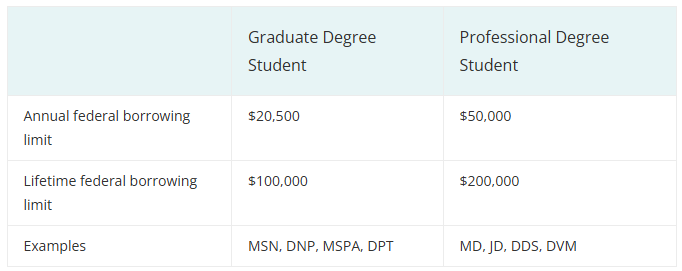
In the ruling, the 11 fields formally defined under the “professional degree” category are:
- Pharmacy (PharmD)
- Dentistry (DDS or DMD)
- Veterinary medicine (DVM)
- Chiropractic (DC or DCM)
- Law (LLB or JD)
- Medicine (MD)
- Optometry (OD)
- Osteopathic medicine (DO)
- Podiatry (DPM, DP, or PodD)
- Theology (MDiv or MHL)
- Clinical psychology (PsyD or PhD)
While this is intended to curb excessive debt and encourage institutions to control costs, it may place added financial pressure on students enrolled in high-cost programs, like nursing.
Reduction or elimination of certain loan options
Some federal loan programs that previously provided expanded access to funding, such as the Grad PLUS loan program, are being reduced or phased out. These programs historically helped bridge the gap between tuition costs and standard borrowing limits, so changes here could significantly affect how students finance their education.
Repayment options
The rule aims to simplify income-driven repayment plans by streamlining plans into two options: the Tiered Standard Plan and the Repayment Assistance Plan. The Tiered Standard Plan will offer fixed monthly payments for 10 to 25 years based on the loan balance. Meanwhile, the Repayment Assistance Plan is an income-based repayment plan that adjusts payments based on income and family size and may waive unpaid interest with on-time payments.
Other perspectives on the finalized rule
The American Nurses Association (ANA) has continued to express significant concern about how these policy changes could impact both advanced nursing education and the long-term stability of the healthcare workforce.
According to the ANA, graduate nursing programs are among the most demanding in healthcare education. This level of preparation is essential to ensure nurses are equipped to deliver safe, high-quality patient care across a wide range of settings.
In addition, the American Association of Colleges of Nursing (AACN) has raised concerns that the updated federal definition doesn’t accurately reflect the rigor and structure of advanced nursing education.
Similarly, the American Hospital Association (AHA) has emphasized the potential impact on the broader healthcare system.
“This could result in fewer essential clinicians at the bedside, leading to longer wait times and reduced access to care,” said Ashley Thompson, Senior Vice President for Public Policy Analysis and Development at the AHA. “We will continue to work to strengthen the health care workforce that patients and communities across the country depend on.”
What to watch as changes take effect
Although the rule has been finalized, students and institutions will begin feeling the impact after it is implemented on July 1, 2026.
As implementation unfolds, nurses, nursing students, and nurse educators should closely monitor several key areas that could signal how the policy is influencing access to advanced nursing education.
Potential program cost adjustments
In response to new borrowing limits, some colleges and universities may reevaluate tuition structures or redesign program formats. This could include efforts to lower costs, shorten program timelines, or offer more flexible pathways that better align with federal loan caps.
Greater reliance on alternative funding sources
With potential gaps in federal loan availability, students may need to explore additional financial support options. This could drive increased availability and competition for:
- Employer-sponsored tuition assistance programs
- State and federal workforce development grants
- Loan repayment and forgiveness incentives tied to service commitments, particularly in underserved areas
Ongoing policy advocacy and reform efforts
Professional organizations, including the ANA, are expected to continue advocating for policy adjustments. Their efforts will likely focus on:
- Reinstating or clearly defining nursing as a professional degree
- Ensuring fair and equitable access to federal student loan programs
- Supporting long-term workforce development initiatives to address ongoing nursing shortages
Conclusion
While the nursing professional degree discussion centers on advanced nursing education, it also reflects broader considerations around how education funding policies may influence the healthcare workforce. Changes to financing structures can affect educational pathways and, over time, may shape provider availability and care delivery in different settings.
Frequently asked questions
What is the finalized federal loan rule for nursing professional degree programs?
The finalized federal loan rule keeps nursing professional degree programs eligible under existing federal student loan guidelines. The decision preserves current borrowing structures for many nursing and healthcare students pursuing advanced education.
How could federal loan rule changes impact nursing students?
Changes to federal student loan policies can affect how much nursing students are able to borrow for tuition, fees, and living expenses. Loan eligibility and borrowing limits may influence access to BSN, MSN, nurse practitioner, and other advanced nursing programs.
Which nursing degree programs are affected by federal student loan policies?
Federal loan policies can impact a wide range of nursing programs, including undergraduate nursing degrees, graduate nursing education, nurse practitioner programs, CRNA programs, and other specialized healthcare training pathways.
Why are nursing organizations paying close attention to federal loan regulations?
Nursing organizations are concerned about maintaining access to affordable education as the healthcare industry continues to face workforce shortages. Many advocates argue that limiting financial aid could reduce the number of students entering or advancing within the nursing profession.
Are there financial aid alternatives for nursing students?
Yes. Nursing students may qualify for scholarships, grants, tuition reimbursement programs, employer-sponsored education assistance, state workforce incentives, and federal or state loan forgiveness programs in addition to traditional student loans.
This article was originally published on the Nurse.com blog and is republished here with permission.