

 By Laxmi Deshpande, Healthcare Digital Transformation Leader, IBM
LinkedIn: Laxmi Deshpande
Healthcare organizations have invested heavily in digital transformation over the past decade. Member portals, mobile applications, personalization platforms, and engagement programs have all become essential components of the healthcare ecosystem.
Yet many Medicare Advantage members still face a fundamental challenge: navigating healthcare.
Members are often expected to understand plan benefits, select providers, schedule appointments, complete Annual Wellness Visits, manage preventive screenings, and coordinate care across multiple systems. While the information may exist, the experience often remains fragmented.
This is where Health Concierge models have the potential to create meaningful change.
A Health Concierge is more than a chatbot or digital assistant. It acts as a personalized guide that helps members navigate their healthcare journey by understanding their profile, healthcare needs, benefits, care gaps, and engagement history. Rather than waiting for members to seek assistance, the Health Concierge proactively recommends the next best action.
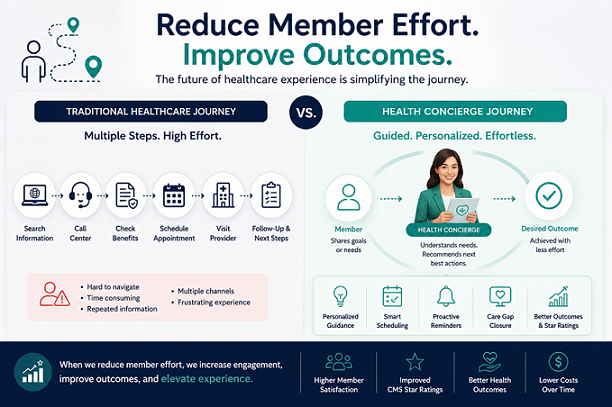
Imagine a Medicare Advantage member receiving personalized guidance such as:
- Your Annual Wellness Visit is due.
- Here are in-network Primary Care Providers accepting new patients.
- Your mammogram screening is recommended next month.
- Transportation benefits are available for your appointment.
- Your care plan and appointment details can be accessed through MyChart.
- Here are the next recommended actions to help you stay on track with your healthcare goals.
Individually, these interactions may seem simple. Collectively, they help remove friction from the healthcare journey and encourage members to take actions that support both personal health outcomes and healthcare quality objectives.
From a healthcare payer perspective, Health Concierge capabilities can help address several areas that influence CMS Star Ratings performance, including Annual Wellness Visit participation, preventive care engagement, member satisfaction, care gap closure initiatives, healthcare navigation effectiveness, and digital engagement.
The opportunity is not simply about applying AI. The real opportunity is creating experiences that reduce member effort while improving healthcare outcomes.
Many organizations focus on measuring engagement, adoption, or satisfaction. Those metrics are important. However, a more fundamental question is emerging:
“How much effort did we remove for the member to achieve their desired health outcome?”
Organizations that successfully answer this question will be better positioned to improve member experiences, strengthen healthcare outcomes, support quality improvement initiatives, and build stronger long-term relationships with the populations they serve.
The future of healthcare engagement will not be defined by more technology. It will be defined by making healthcare easier to navigate. And that is where AI-powered Health Concierge solutions can make a meaningful difference.